

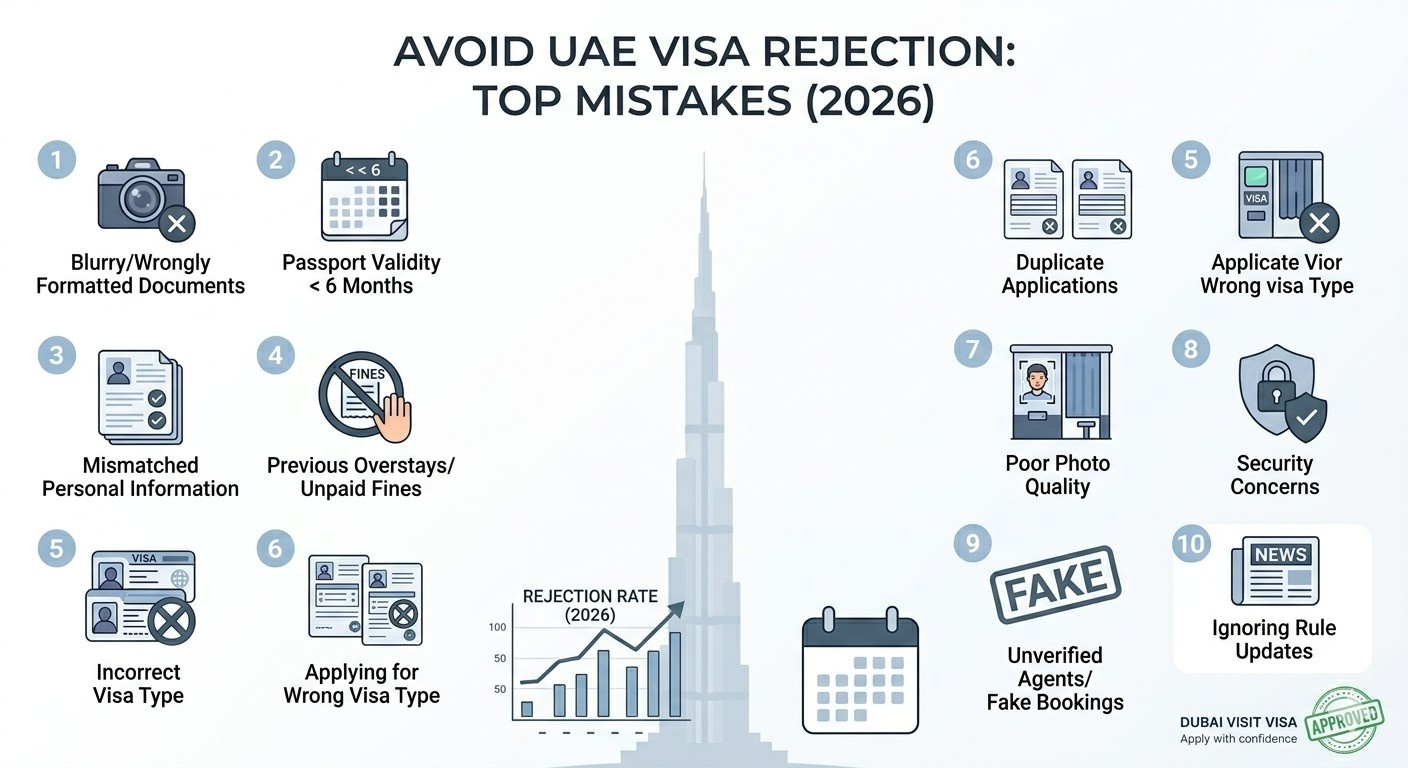
Dubai welcomed 1.99 million visitors in January of 2026 alone, according to statistics released by GrabOnUAE. The UK remains one of its top three source markets. But behind that record traffic sits a quieter story of the UAE visa rejection reasons multiplying, and rejections that once took days now happen in minutes, thanks to AI-powered screening rolled out by the Federal Authority for Identity, Citizenship, Customs and Port Security (ICP) and Dubai’s GDRFA.
The frustrating part? Most rejections are not because of who you are. They are because of small, fixable visa application errors. This guide breaks down the ten UAE visa mistakes sending British-based applicants into the rejection pile in 2026, with data, real reason codes, and exactly what to do instead.
If you would rather skip the guesswork, the Dubai visa from UK application process at Dubai Visit Visa walks you through every document check before submission. One review, one approval, no re-applications.
Why UAE Visa Rejection Rates Are Climbing in 2026
The UAE immigration rules of 2026 are not stricter on paper. They are stricter in practice because almost every check is now automated.
Three shifts explain the spike in Dubai visa rejection 2026 cases:
- AI-led pre-screening: From May 2026, every new work permit application will run through an AI and robotics platform built jointly by ICP and MoHRE. Tourist visa applications use a parallel risk-scoring layer.
- Cross-database matching: Your application now pings the ICP, GDRFA, MoHRE, and fines databases simultaneously. A single mismatch surfaces in seconds.
- Higher volumes, higher scrutiny: Dubai processed a record tourist influx in Q1 of 2026, and the immigration response has been to tighten, not loosen, document standards.
| Feature | Old Process (Pre-2024) | 2026 Process |
| Document Review | Manual officer review | AI flags + officer review of flagged cases |
| Security Cross-check | Within ICP only | ICP + GDRFA + MoHRE + Fines + Interpol watch |
| Rejection Reason | Detailed letter | Coded message (e.g., Security-01) |
| Re-application | Often the same day | Must clear the underlying flag first |
Mistake 1: Submitting Blurry, Cropped, or Wrongly Formatted Documents
This is the single largest cause of UAE visa rejection reasons in 2026 and the most preventable. Industry reports consistently rank document quality issues as the #1 trigger for instant rejection.
Common scan failures
- Blurry passport bio-page where the MRZ (the two-line code at the bottom) is unreadable
- Cropped corners that hide the passport number or expiry date
- Dark or yellow-tinted photos taken in poor light
- Documents in unsupported formats (HEIC, TIFF) when PDF or JPG is required
Quick fix checklist
- Scan in daylight against a white surface, or use a scanning app (Adobe Scan, Microsoft Lens) or a flatbed scanner
- Verify the MRZ at the bottom of your passport is fully visible and crisp
- Save as PDF or JPG, under 2 MB but over 200 KB
Mistake 2: Applying With a Passport Near Expiry or in Poor Condition
A passport with under six months’ validity is one of the fastest paths to a Dubai visa rejected stamp. This rule is non-negotiable across all UAE entry requirements.
Passport Condition | 2026 Outcome |
Under 6 months’ validity | Auto-rejection: Systems now automatically flag expiry dates at the point of application or check-in. |
Damaged binding or water-damaged pages | Manual review: Usually results in rejection, as damaged biodata pages or tampered stitching raises security alarms. |
| Handwritten passports | Auto-rejection: ICAO standards have rendered non-machine-readable passports obsolete for most international transit. |
| Less than 2 blank pages | Rejection or entry refusal: Many jurisdictions require at least two clear pages for entry/exit stamps and visa stickers. |
If your passport is even slightly damaged, like a torn corner of the bio-page, a faded photo, or a coffee stain, renew it before you apply. The AI flags damaged documents because they cannot be biometrically verified.
Not sure if your passport will pass the validity check? Our expert from Dubai Visit Visa confirms your Dubai tourist visa approval odds before you pay anything.
Mistake 3: Entering Incorrect or Mismatched Personal Information
This is where AI screening hits hardest. The system cross-checks your form against your passport’s MRZ, your flight booking, and your hotel reservation. Any inconsistency triggers rejection.
The most common mismatches
- Name order swapped (given name and surname reversed)
- Initials used on the form when the full name is on the passport (or vice versa)
- Date of birth entered in US format (MM/DD/YYYY) when the system expects DD/MM/YYYY
- Passport number with a missing leading zero or letter
- Different spellings of the same name across passport, flight ticket, and hotel booking (e.g., Mohammad vs Mohammed)
These look harmless. They are not. A 2026 analysis flagged name and passport number errors as one of the top reasons for UAE tourist visa mistakes being penalised this year.
Mistake 4: A Previous UAE Overstay or Unpaid Fine on Record
The fines database is now wired directly into the visa system. An old AED 50 fine from a 2019 trip can hold up your 2026 application, and it will not tell you why.
What gets flagged
- Overstaying a previous visa, even by a single day
- Unpaid traffic fines from a prior visit (rentals, taxis, scooters)
- An old work or residence visa that was never formally cancelled by an employer
- Any record of absconding or sponsorship breach
- Deportation history (these are usually permanent flags)
Check before you apply. You can run a free fine and visa history check on the ICP Smart Services portal or the GDRFA app for Dubai-issued visas. If anything is outstanding, clear it first.
If you held a UAE work visa previously and exited without formal cancellation, the system may still show you as “active”, blocking any new application until your old employer or a PRO service closes the file.
Mistake 5: Applying for the Wrong UAE Visa Type
The 2026 UAE visa categories have multiplied, and applying under the wrong one is treated as misrepresentation, not a clerical error.
| Visa Type | Best For | Common Confusion |
| Tourist Visa (30/60/90 days) | Holidays and sightseeing | Frequently confused with the Visit Visa, this is sponsored by a travel agency or airline. |
Visit Visa | Family or friends visiting a resident | Confused with the Tourist Visa, this typically requires a resident sponsor to provide a security deposit. |
Transit Visa (48/96 hours) | Short layovers | Often used incorrectly for stays exceeding 96 hours; these cannot be extended. |
Multi-entry Tourist | Frequent business travellers | Often applied for without a documented travel history, which can lead to higher rejection rates. |
Single-entry vs multiple-entry is the most common slip-up. Applicants who plan to leave and re-enter the UAE during a single trip but apply for a single entry get auto-rejected on re-entry attempts.
Mistake 6: Duplicate Dubai Visa Applications
This is where applicants going through multiple agents lose visas and money. If two applications hit the system under your passport number, both fail.
How duplicates happen
- You apply through Agent A, get nervous about timing, and apply through Agent B just in case
- A family member books a visa for you while you have one in progress
- You forget that a previous unsuccessful application is still showing as “Pending” rather than “Closed”
- An underexperienced agent submits multiple times to improve odds
The 2026 ICP system auto-cancels duplicates and flags the passport for manual review on any future application. Stick to one trusted channel.
Applying through a single, licensed provider eliminates the duplicate-application risk entirely. The Dubai visa from UK team at Dubai Visit Visa tracks every application end-to-end, so nothing gets submitted twice.
Mistake 7: Poor Quality Passport Photos That Fail Biometric Checks
Passport photo failures are the most underestimated of all UAE tourist visa mistakes. The AI now runs facial-geometry matching against your passport photo and rejects mismatches.
The 2026 photo specification
- Plain white background (no off-white, no shadows)
- The face fills 70–80% of the frame
- Neutral expression, mouth closed
- No filters, no smoothing, no Instagram edits
- No glasses (even clear ones)
- Taken within the last six months
A 2026-printed photo of a 2018 face will be flagged. The biometric system compares facial landmarks; if you have changed weight significantly or grown a beard, retake the photo.
Mistake 8: Criminal Records or Security Concerns
The 2026 UAE immigration system is integrated with international security databases. Even minor unresolved charges in your home country can surface.
Common security-related flags
- Pending or unresolved criminal cases (anywhere in the world)
- Past convictions that have not been declared if asked
- Watchlist matches (Sometimes triggered by name similarity. These can be cleared)
- Prior deportations from any GCC country
- Visa fraud history
If you have a minor historical conviction (spent under UK law, for example), declare it where asked. Hiding it and being caught is a far worse outcome than disclosing it. Reason codes like Security-01 are increasingly common for first-time applicants from certain regions, and they often require expert resolution rather than reapplication.
Mistake 9: Using Unverified Agents, Fake Bookings, or Edited Documents
This is the single most damaging UAE tourist visa mistake of 2026 and the one that creates permanent records.
What the AI now detects
- Hotel bookings that do not exist in partner databases
- Bank statements with photoshopped balances (metadata gives them away)
- Flight tickets booked through unverified third parties
- Cropped or edited employment letters
- Sponsor letters from companies that do not exist on the MoHRE register
A single instance of document fraud can result in a long-term ban from the UAE. Always verify your agent is licensed by the Department of Economy and Tourism (DET) or operates under a registered UK travel partner.
Mistake 10: Ignoring UAE Entry Rule Updates in 2026
UAE immigration rules have changed materially since 2024, and applying based on outdated guides is a quiet but common rejection trigger.
Key 2026 updates British-based applicants miss
- Mandatory travel insurance for some visa categories
- New 60-day tourist visa option with different document requirements
- Updated sponsorship rules for visit visas
- 5-year multi-entry visa eligibility tightening (now requires bank balance proof)
- New documentation rules for travellers from certain nationalities, even if UK residents
Need to know which 2026 rules apply to your nationality and visa type? Get a free Dubai visa from UK pre-application review at Dubai Visit Visa. We update our compliance checks every time the UAE authorities publish a change.
How to Avoid UAE Visa Rejection in 2026: Your Pre-Submission Checklist
The good news is that most UAE visa rejection reasons are clustered around the same fixable errors. Run through this checklist before you submit, and you cover 90%+ of all rejection triggers.
Documentation
- Every name, date, and number matches your passport exactly
- Scans are sharp, colour, and complete (no cropped edges)
- A passport has at least 6 months’ validity and 2 blank pages
- The photo is a recent, white-background biometric photo
- Travel insurance arranged where required
History
- No outstanding UAE fines (checked via ICP/GDRFA)
- Any previous UAE visa is formally cancelled
- No pending applications under your passport number
- Any past rejections or violations are disclosed honestly
Application
- Single application through one licensed provider
- Correct visa type for your travel purpose and duration
- Submitted at least 7–14 working days before travel
- All supporting documents (return ticket, hotel, financials) are real and verifiable
This is visa rejection prevention in its simplest form. Get the basics right, and the AI screener has nothing to flag.
The Bottom Line: Get It Right the First Time
The Dubai visa rejection 2026 wave is not about Dubai becoming unwelcoming. It is about Dubai becoming faster, more automated, and less forgiving of sloppy applications. The applicants who get rejected almost always made one or more of the ten UAE visa mistakes above. The applicants who get approved tend to do one thing. They take the application seriously from the first click.
The cost of a re-application is not just the fee. It is the rebooked flight, the lost hotel deposit, or the explanation to your boss or family. Treat the application like the small but important document it is, and use a licensed channel that knows the current rules. The Dubai visa from UK process at Dubai Visit Visa is built specifically for that: one application, current rules, and full document review before submission.
FAQs: Dubai Visa Rejection 2026
Q. Can I reapply immediately after a Dubai visa rejection?
A. If the rejection was for a fixable error (blurry scan, wrong photo), you can reapply once corrected. If it were for a flagged record (overstay, security), you must clear the underlying issue first.
Q. How long does UAE visa approval take in 2026?
A. Standard processing is 24–48 working hours. Express processing can deliver approvals in 12–24 hours.
Q. Does a previous UAE overstay always cause rejection?
A. Not always, but it requires the fine to be fully paid and cleared on the ICP system. Unpaid overstay fines are an almost-certain rejection trigger.
Q. Can a wrong passport number cause visa rejection?
A. Yes. Even a single character mismatch causes immediate rejection because the AI cannot match the application to a valid passport record.
Q. What happens to my visa fee if my Dubai visa is rejected?
A. Visa fees are generally non-refundable on rejection.
The explanation fits well with the broader discussion of price action.
earnings season investing